
Key Takeaways
- Watch photography needs expert control of reflections, fine detail, and focus across metal, glass, and straps.
- Pair clean product shots for ecommerce listings with lifestyle images for ads, social, and brand storytelling.
- Clean the watch, set the hands, control reflections, and lock a shot list to cut reshoots and retouching costs.
- Price scales with image count, technical needs, models, props, direction, retouching, and licensing—not a flat rate.
Why Watch Photography Requires Specialized Technique
Photographing a watch means managing light, texture, and scale in a space smaller than your palm. A single timepiece packs reflective crystal, polished metal, brushed finishes, and fine dial details into one tiny subject—so the technique has to go well beyond basic product photography.
Reflective materials make watches difficult to photograph
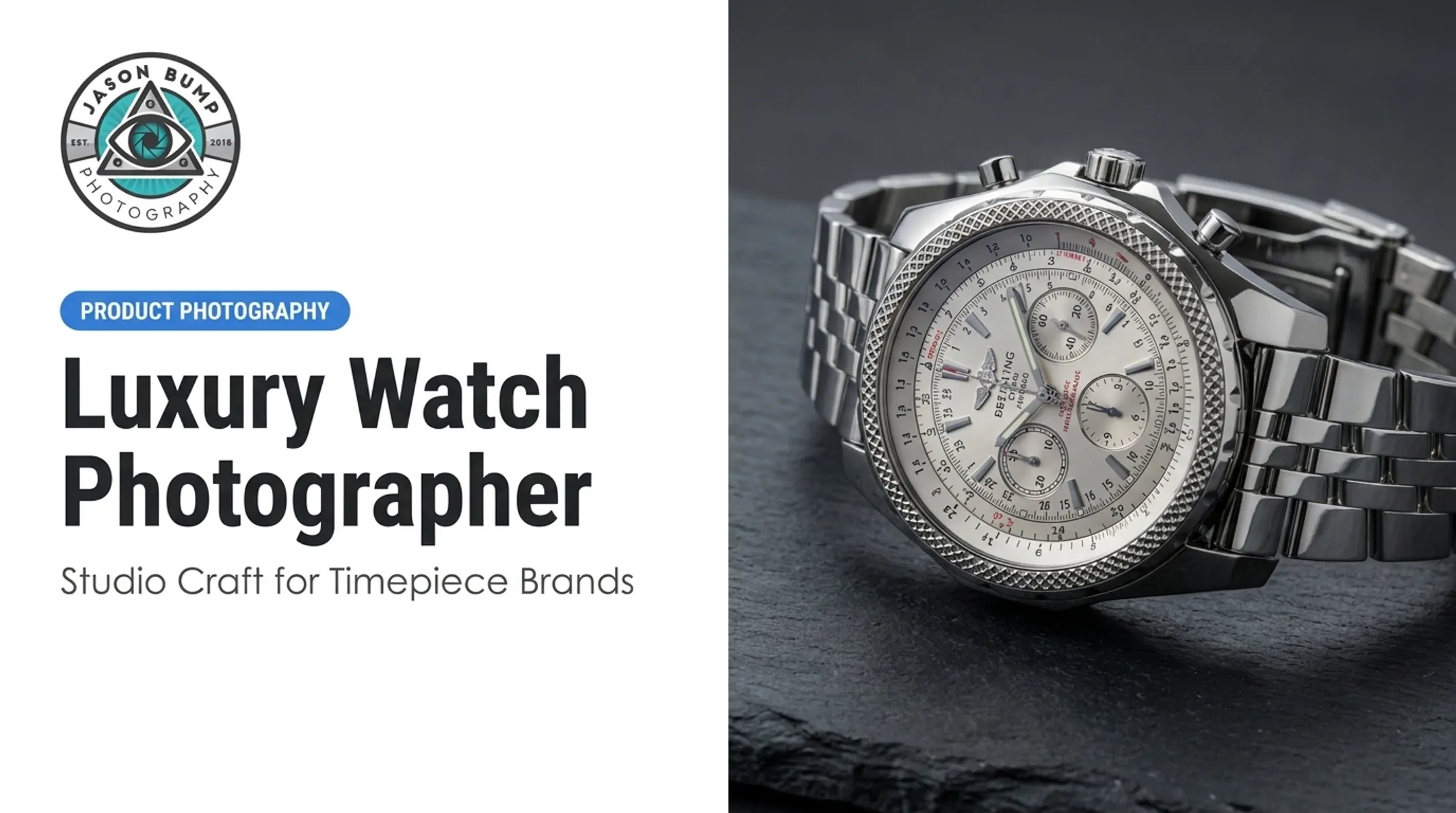
A watch is an assembly of contrasting materials. The sapphire crystal, polished steel case, brushed bracelet links, leather strap, and matte dial all reflect or absorb light differently.
Without precise control, those reflections ruin the shot. Unmanaged light creates hotspots that blow out detail, hide the dial behind glare, or distort the case shape.
Large diffused sources, white reflectors, and black flags shape those reflections so the true form and finish read clearly.
Small products contain significant visual detail
Every element of a watch is a deliberate design choice, from the texture of the dial to the brushing on the case. Communicating this craftsmanship online requires macro photography techniques.
- Brand name, indices, hands, and complications must stay perfectly sharp and readable
- Close-up depth of field is extremely shallow—the case front can be sharp while the strap or crown goes soft. Focus stacking (combining multiple frames) is often required for edge-to-edge sharpness
Accuracy, cleanliness, and consistency affect customer confidence
When a customer can't hold the product, the images must build trust. Every photo needs to be a clean, accurate, and consistent representation of the timepiece. This means meticulous preparation is essential.
Dust, fingerprints, and lint invisible to the naked eye become glaring flaws under macro lenses and studio lighting. On pre-owned watches, genuine wear should stay visible—without extra smudges competing for attention.
Across a full ecommerce catalog, consistent angles, scale, color, and hand position let shoppers compare models easily and trust what they see.
Product-only and lifestyle images solve different problems
That same need for trust and clarity shows up in two different image types:
- Product-only photography — Clean, detailed shots on a simple (usually pure white) background for product pages and marketplace listings. Job: inform and show the watch accurately.
- Lifestyle photography — The watch on a wrist, in activity, or in a styled scene. Job: connect emotionally, signal brand identity, and show how it fits a way of life.
Lifestyle shoots with models, locations, wardrobe, and props are more complex than studio product work—but you need both to sell the watch and the brand.

Plan a Watch Product Photography Shoot
A successful watch photoshoot happens long before the camera comes out of the bag. It begins with a clear plan rooted in your brand, your audience, and your business goals.
Start with the product, audience, and commercial objective
The visual direction should be an extension of the watch itself. A rugged dive watch demands a different photographic style than a minimalist dress watch. Before planning shots, define your strategy:
- Product: Is it a luxury, sport, fashion, or field watch?
- Audience: Who is your target customer and what do they value?
- Objective: Where will the images run? Amazon listings, social ads, and lookbooks each need different framing and detail.
Build a mood board and visual brief
A mood board is a visual collage that aligns everyone—the photographer, stylist, model, and client—on the creative direction. It should document the desired feeling of the shoot, whether it's refined and technical or adventurous and rugged.
Your visual brief should include references for:
- Mood and color palette
- Lighting style (for example, hard and dramatic vs. soft and airy)
- Backgrounds, props, and locations
- Wardrobe and model casting
- Composition examples and angles to capture
- Examples of images you want to avoid
Prepare the watch before it reaches the set
Proper preparation saves hours of retouching and prevents frustrating delays.
- Clean everything: Wipe crystal, case, and strap with a lint-free microfiber cloth and air blower; wear cotton gloves to avoid fingerprints.
- Check the details: Ensure the dial is clean and the strap is in perfect condition.
- Document everything: Organize watches with clear product identifiers. For high-value or pre-owned pieces, document any existing marks or scratches beforehand.
- Secure logistics: For shipped products, confirm secure transport, inventory tracking, and insurance responsibilities.
Set the hands and establish a consistent product position
The industry standard for setting watch hands is 10:10. This position creates a symmetrical, balanced look that frames the brand logo (which is usually below the 12). However, always be prepared to adjust the hands if they cover a date window, sub-dial, or other key feature.
For catalog work, establish a repeatable orientation for the crown (usually facing right or up), strap, and buckle. This consistency makes the entire collection look professional and cohesive.
Create a complete shot list before production
Never start a shoot without a detailed shot list. This ensures you capture every image you need for every channel.
Core E-commerce Shot List:
- Front view (dial straight on)
- ¾ angle view (showing case depth)
- Side profile (showing crown and case thickness)
- Case back view
- Strap or bracelet detail
- Dial macro shot
- Packaging/box shot
Campaign & Lifestyle Shot List:
- On-wrist shots (various angles)
- Model interacting with the watch (such as adjusting the crown)
- Detail crops for social media
- Hero compositions with negative space for ad copy
- Both vertical and horizontal framing options

Lighting, Composition, and Capture Techniques
Once the shot list is set, execution comes down to a stable camera rig, controlled light, and angles that show the watch clearly.
Build a stable and controlled camera setup
Consistency starts with a stable foundation. A professional watch setup typically includes:
- A camera that can produce high-resolution files.
- A macro lens for capturing fine details without distortion.
- A sturdy tripod to eliminate camera shake.
- Remote or tethered capture to a computer for reviewing sharpness and reflections in real-time.
Gear gets you consistency; lighting skill and art direction determine whether metal and crystal look premium or flat.
Control reflections with diffusion, flags, and reflectors
Managing reflections is the single most important technical skill in watch photography. You want controlled reflections that shape the case and crystal, not a total wipe that leaves metal and glass looking flat.
- Diffusion: large soft sources (softbox or bounce through a panel) lay smooth gradients across crystal and polished metal.
- Reflectors: small white cards or foam core bounce light into dark areas and open shadow detail.
- Flags: small black cards block spill and cut a clean dark edge on a polished case so the shape reads clearly.
Keep the set fully controlled. Mixing studio lights with window light introduces conflicting color temperatures and stray reflections that are hard to fix later.

Use macro focus and focus stacking when the image requires it
For ultra-sharp e-commerce images, focus stacking is often essential. This technique involves capturing multiple photos of the watch at different focus points—one on the hands, one on the indices, one on the crown—and then merging them in post-production. Merged, the frame holds sharpness from the hands through the indices and crown in one commercially clean file.
For more artistic lifestyle or hero images, a selective focus can be more appropriate, drawing the viewer's eye to a specific feature while letting the background fall softly out of focus.
Choose angles and compositions that reveal the product
Different angles tell different parts of the story.
- Front views showcase the dial design.
- ¾ views reveal the depth and finishing of the case.
- Side profiles highlight the case thickness and crown details.
- Back views document engravings or an exhibition caseback.
Leave intentional space around the product. That breathing room supports flexible crops for social, ads, and website layouts.
Capture lifestyle images that feel natural and commercially useful
When a model is involved, direct poses that show the watch naturally: adjusting a cuff, holding a cup, or resting a hand on a table.
Wardrobe, props, and location should support the watch's story, not compete with it. Aim for a mix of tight close-ups and wider environmental frames so the brand leaves with a versatile asset set.

Build a Watch Image Library for E-commerce and Marketing
A single photoshoot should produce a complete image library for every sales and marketing channel—if you plan deliverables before you shoot.
Match product-only photography to sales and catalog requirements
For e-commerce sites and marketplaces like Amazon or eBay, your images must be clean, consistent, and compliant. Customers need to evaluate details and compare models, so these images prioritize clarity over creativity.
While requirements can change, major platforms generally look for:
- Amazon: Main image on pure white, product filling at least 85% of the frame, 1,000+ pixels on the longest side for zoom
- Walmart: Seamless white main image; 2,000 x 2,000 pixels recommended
- eBay: 1,600 x 1,600 pixels; up to 24 photos per listing so you can show every angle
Use lifestyle and hero photography to communicate context
White-background shots show design and detail. Lifestyle frames—a watch on a wrist mid-hike, for example—add scale, real-world use, and brand feel that catalog images can’t carry alone.
Keep styling authentic: pair an adventure watch with outdoor elements; match a dress watch with refined textures and materials.

Plan deliverables for multiple channels
One photoshoot can fuel your entire marketing calendar if you plan ahead. Before the shoot, discuss the final deliverables with your photographer.
Consider all the formats you'll need:
- High-resolution images for product pages and print
- Web-optimized files for fast-loading sites
- Square crops for Instagram posts
- Vertical crops for Stories and Reels
- Horizontal banners for homepage and email
- Images with negative space for ad copy
When those formats are locked before the shoot, every frame can be composed and lit for its final crop—not patched later.
Retouching, Delivery, and Budget Decisions
Post-production and budgeting lock in image quality and decide what you actually pay for the shoot.
Use post-production to refine—not misrepresent—the watch
Professional retouching is the final polish: clean up the frame so the watch looks true to life on screen. Standard post-production for watches includes:
- Dust and scratch removal
- Cleaning up distracting reflections
- Color correction for accuracy
- Blending focus-stacked images
- Removing any temporary supports used during the shoot
- Ensuring the background is clean and consistent Preserve the watch's real materials, proportions, and colors. Buyers should get a polished frame that still matches what arrives in the box.
Establish a quality-control and delivery process
Before final delivery, review proofs against the brief. Confirm:
- Sharpness across case, dial, and bracelet
- Dial text and indices are readable
- Color consistency from shot to shot
- Full coverage of the agreed shot list Deliver files in organized folders with clear names. A standard package includes high-resolution masters plus web-ready exports sized for every channel you planned for.
What drives photography cost—and when to outsource
Watch photo pricing follows project scope, not a flat rate. Key cost factors include:
- Number of watches and final images required
- Complexity (product-only vs. lifestyle with models)
- Creative direction and pre-production planning
- Retouching intensity (for example, focus stacking)
- Models, props, and location fees
- Image licensing and usage rights
- Turnaround time If you need conversion-focused images without building an in-house team, a specialized studio is usually the efficient path. Jason Bump Photography runs a director-led process from planning through final delivery. Our nationwide ship-in product photography service starts at $39 per image, so US brands can mail products in and receive commerce-ready files without maintaining studio overhead.
Frequently Asked Questions
How much should I pay for product photography?
Pricing depends entirely on the project's scope, including the number of images, technical needs (like focus stacking), retouching, models, and licensing. Request a custom quote based on a detailed shot list for an accurate price.
What is the best lens for watch photography?
A macro lens (typically around 100mm) is ideal for capturing the fine details of a watch without distortion. However, expert lighting, a stable tripod, and reflection control are just as important as the specific lens you choose.
How do you photograph a watch without reflections?
Reflections are shaped, not removed. Use large, diffused light sources for soft highlights, and black and white cards to add or subtract light so those reflections define the watch's form.
Should watch product photos be on a white background or in a lifestyle setting?
You need both. Use clean, white-background images for your main e-commerce product listings and marketplaces. Use lifestyle images in ads, on social, and on your site to show the watch in use and support the brand story.
Does watch photography require focus stacking?
Focus stacking is highly recommended for detailed e-commerce close-ups to ensure every part of the watch is sharp. For more creative or mood-driven lifestyle images, selective focus often works better.
How should I prepare a watch for a photoshoot?
Carefully clean the watch with a microfiber cloth and air blower, and handle it with gloves. Confirm the hands are set correctly (usually 10:10), document its condition, and provide a clear shot list to the photographer before the shoot begins.